
Companies understand how valuable the data you create each day is, and they bend over backwards to get their hands on it. The most effective way they take it from you is by drowning you in terminology. The data economy loves its jargon, and marketing materials read like a foreign language so companies can hide their activities in plain sight. The three main ways companies talk about buying, selling, and collecting your data are through zero-party, first-party, and third-party exchanges. Knowing the difference between them is how you can understand whether your data is kept under your control or taken by middlemen that profit on it for themselves. In this article, I will explain these three terms and provide you with simple tips to protect your property.
Zero-Party Data: Information You Voluntarily Provide
Marco recently moved into a friendly neighborhood. Excited to meet his new next-door neighbor, Karen, Marco introduced himself. During their conversation, he mentioned a few things about himself, like he has two kids and a pit bull named Tinkerbell, he works from home on Fridays, and he drives 2 hours each way to work. Normal pleasantries between neighbors that mutually benefit by keeping in each other’s good graces.
Zero-party data is the stuff you knowingly, voluntarily give to a company, like Marco telling Karen about his kids and Tinkerbell. The defining trait of zero-party data is intent. You know you’re sharing, and you chose to do it. It’s highly valued in the data economy because the data comes straight from the source, is usually authentic, and is legally safe to use.
In the data economy, these are traditionally the “About me” prompts you complete, reviews or comments you leave, and the surveys you complete. The asks seem reasonable, sometimes incessant, and can often be mandatory to use an app or service. Unless you have a very good reason to trust the company receiving this data, consider declining them all or making a game of lying on them. Just because a company is asking for something does not mean you MUST answer it with a hand on the Bible.
First-Party Data: Things a Company Observes About You
Following their exchange, Karen decided she wanted to learn more about her new neighbor and started a diary of everything she observed about Marco and his family. She could easily figure when Marco’s family arrived home by logging when the living room lights turned on, that Marco’s wife tended to her flowers five days a week andon most Friday evenings, she spotted Marco sparking up a cigar and sipping a drink on the back patio. Karen could also infer things about Marco’s lifestyle based on the types of cars she observed parked in Marco’s driveway, the number of Amazon Prime deliveries the family received each week, and who else in the neighborhood spent time at Marco’s house.
First-party data is what a company collects about you by watching you from their own property or product. Karen’s decision to create a diary about Marco based on things she saw from her own property is an example of how first-party data is collected in the data economy. In the data economy, this is the streaming service tracking where you are watching from, the store app logging what and when you make a purchase, and the social media site mapping your friends and family network. This type of data generally stays under the control of the company observing you, which sets the rules over how it gets used. Sometimes it work in your favor, like a neighbor watering your plants while the family’s away. Sometimes it works against you, like Karen telling Marco’s employer she saw him with a cigar and a drink on the patio at 3pm last Friday.
Stopping first-party collection requires a little bit of creativity.
Third-Party Data: What Random Companies Collected About You
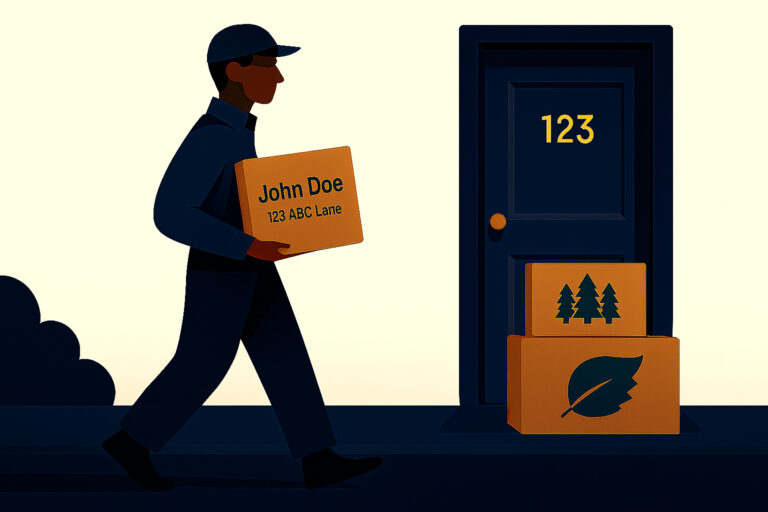
A diary of her own observations wasn’t enough for Karen. She wanted to know everything Marco’s family did once they left the neighborhood. To make Marco’s family easy to identify, Karen combined the data provided by Marco (zero-party data) and her logs (first-party data) and gave it to private investigators. The PI’s hid near the plant nursery and recorded what Marco’s wife purchased and when. They found Marco’s car at the local grocery store, documented each item Marco browsed and purchased, and followed Marco to his doctor’s appointment. This went on for years and continued after Marco and his family moved to a new home. Even after Karen stopped using the private investigators, all of Marco’s data stayed with the private investigators who could do whatever they wanted with it.
Third-party data is information about you collected by companies you’ve never met, such as data brokers and advertising technology companies. They basically stamp a barcode on you; they slyly inject their trackers directly into the apps and services to take your data, and sell it to anyone willing to pay. They do all this without getting your consent and compensating you for using the property you created.
How to Protect Your Data
Knowing how companies take your property is one thing. Doing something about is another. Here are a few things you can do to make it difficult for companies to monetize your data without your permission:
Limit what companies can observe
- The first step is at sign-up; do not submit an email address you use elsewhere. Apple’s email-masking, and similar services from others, make this process significantly easier than trying to manage a thousand different email addresses yourself.
- Never supply your phone number or address unless you absolutely must do so. Almost every app you’ll use asks for this data but does not require it to run the service. Even if the prompt seems like you need to give this data, odds are it is not needed. Decline or consider submitting a fake number.
- Disable location sharing with the app [link to article]. Location data is very valuable; used to track you in the real and digital world. Most apps do not need it…although that won’t stop them from asking!
- Deny access to your contacts.
Android: Settings -> Security & privacy -> Privacy controls -> Permission manager -> Contacts and accounts; or
iOS: Settings -> Privacy & Security -> Contacts
Make yourself harder to track
- Delete your device’s Advertising ID. This is the primary barcode used to track you around the internet.
- Use a Virtual Private Network (VPN) from a reputable company to access the app or service. Like an Advertising ID, your IP address functions like a license plate for your device and allows others to track where you go. A VPN conceals this data.
- Turn off personalization on your device.
Android: Settings -> Security & privacy -> More security & privacy; or
iOS: Settings -> Privacy & Security -> Apple Advertising - Turn off Wi-Fi and Bluetooth scanning. Scanning allows companies to precisely locate physically where your device is located without GPS.
Android: Settings -> Location -> Location services; or
iOS: Settings -> Location -> Location services -> System Services -> Networking & Wireless toggle
How to Break the Wheel
Companies have grown WAY too comfortable taking what’s yours and profiting from it without your consent. The issue is not black and white and requires treating you like a valuable stakeholder. Sometimes exchanging your data for a service works in your favor, like when your data is used to show you content about a topic you like, receive relevant information about products you’re searching, and make the products you use better. Other times it’s used against you, like when a store identifies you as a new parent and shows you higher-priced baby thermometers, a location-tracking company sells your driving data that increases your insurance rates, and an airline uses your data to set ticket prices.[1],[2],[3]
It doesn’t have to work this way. You need a seat at the table to control how your data can be used.
The industry will never treat you like a valuable owner; it’s more profitable for them to take your property instead. To make them take you seriously, you can cut off access to your data and use collective representation to negotiate for terms that benefit you. My Data Union exists to fight for you in an industry that ignores what you want. Let’s flip the script; I’ll show you options you didn’t know you had, listen to what you want, and execute on your behalf.
[1] https://www.ftc.gov/news-events/news/press-releases/2025/01/ftc-surveillance-pricing-study-indicates-wide-range-personal-data-used-set-individualized-consumer
[2] https://www.texasattorneygeneral.gov/news/releases/attorney-general-ken-paxton-sues-allstate-and-arity-unlawfully-collecting-using-and-selling-over-45
[3] https://www.cbsnews.com/news/jetblue-lawsuit-surveillance-pricing-personal-data-tickets/