

My comedy idol, George Carlin, spent the last part of his fifty-year career perfecting the portrayal of a cranky, cynical old man. He loved to enthusiastically expose broken systems and how their designs keep ordinary people powerless. Proving that some things never change, I believe his jokes about rigged systems in his penultimate album, Life is Worth Losing, accurately describe today’s data economy. This article borrows a couple salient quotes from the album to highlight how people feel about managing their data.
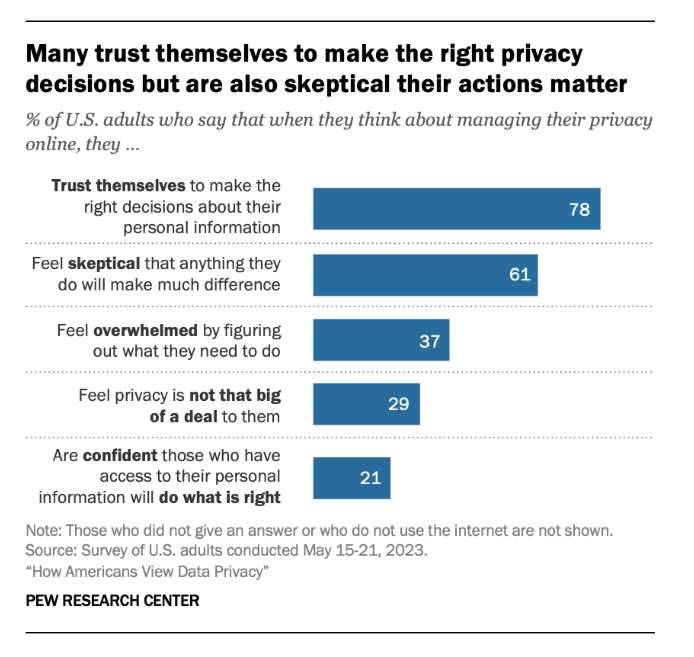
According to a study conducted by the Pew Research Center in 2023, only 21% of Americans are confident that those with access to their information will do what’s right.[1] If you’re among the other 79%, your skepticism is earned. The data economy wasn’t built to serve you. It was built to extract value from you.
Every day, companies collect enormous amounts of information about your life: information about where you go, what you search, what you buy, who you talk to, how long you linger on a page, what time you wake up, how far you drive, what apps you open, and what you enjoy are valuable. While this may seem trivial, I believe it could be worth thousands of dollars per year to the average person, if managed correctly. But you don’t manage it. You don’t see it. It’s impossible to even know the full extent of what’s being collected now. Instead, that value flows to data aggregators, data brokers, and data buyers. Everyone except you, the person who created it, is making money from your property.
How did this happen? Through tactics designed to strip away your ability to participate.
“You have no choice. You have owners.”
Companies gain access to your data through automatic opt-ins buried in settings you never opened. You’re enrolled in programs you didn’t know existed, sharing information you never explicitly agreed to share. Your terms of service change without meaningful notice, and new reasons are always found to take more of your data. By the time you learn about any of it, much less object, your information has already been harvested.
When you do encounter a choice, it’s usually a false dilemma where you must either accept vague, intrusive terms or not use the product at all. There’s no negotiation, no middle ground, no option to say, “I’ll share this but not that,” and no transparency to see what companies pay for your data. It’s an all-or-nothing proposition dressed up as consent. From there, your data then circulates through layers of data brokers, moving fast enough to ensure that no single company is held accountable for how your information is collected, sold, or used. By the time your data reaches its destination, you’ve been completely removed from the process with no way to control what’s yours.
This is why 61% of Americans feel skeptical that anything they do will make much difference when it comes to their data.[1] They don’t need Carlin-level skepticism to recognize the system wasn’t built for their participation. The average person has no practical way to control, monetize, or protect their own property. The problem isn’t awareness or willingness, it’s that the infrastructure to act on either doesn’t exist.
But here’s what the same study also reveals that makes me hopeful: 78% of Americans trust themselves to make the right decisions about their data, if given the opportunity.[1] People don’t need to be told what to do with their data. Like I described in a previous article, what’s acceptable to share is subjective and comes with nuance. Companies with conflicting interests to their users are not reliable to decide such things on their users’ behalf. What people need is straightforward: the infrastructure to communicate their own preferences to the marketplace and representation to enforce those preferences once they’ve made them.
I created My Data Union to fill this gap in the marketplace. My Data Union provides its members with the tools, representation, and market access that people need to manage their valuable property. Its purpose is to be a trustworthy steward of its members’ data in the marketplace. Whether you want to sell a lot of your data for the highest possible price, or keep your property private entirely, My Data Union acts on your behalf. Your property. Your profit. Your terms.
As Carlin put it: “It’s a big club… and you ain’t in it.”
But you should be—and you can make money while being part of the solution. Ready to be an active participant? Sign up to be first to know when we launch. You’ll also receive weekly insights while you wait.
[1] https://pewrsr.ch/3tH4of2


How often can I expect benefits for transactions related to my data?
How much money is estimated for data transactions and in what periods?
Depending on how people choose to manage their data, i.e. how much they would like to share, how effectively they are at protecting their data, etc., I believe the average person could generate thousands of dollars per year. The value comes from four places:
1) Removing most data brokers from the industry and transferring their value to consumers (decreasing competition and friction);
2) Finding new buyers/use cases for consumer data (increasing demand);
3) Finding new, valuable pairings from consumers (increasing demand and price); and
4) Limiting and controlling how sources access consumer data (decreasing fraud and increasing demand)
It boils down to this: we can get a lot more bang for our buck when it comes to data. It is being significantly undervalued and misused at present, so if consumers are interested in managing their property better than they are now, there are meaningful gains to be made.
– Ryan