
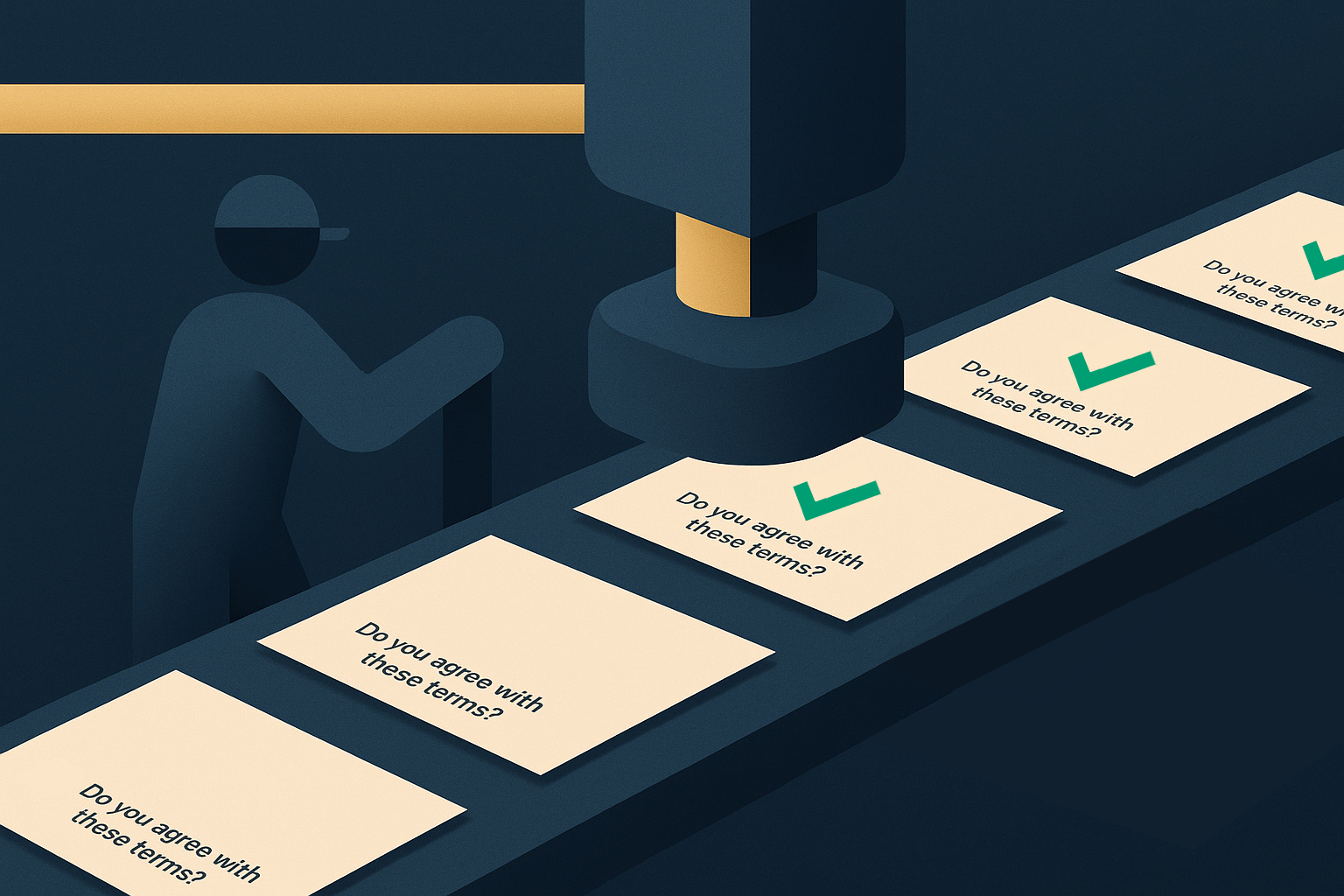
Companies understand that consumers can be pressured to give up something valuable for nothing due to their lack of negotiating leverage and available resources. Buried within user profile settings and vague disclosures, their users implicitly grant consent to exchanges offering users no tangible benefits. People are conditioned to accept this practice as normal because it happens daily, the terms are not clear, and they lack practical options. Let’s take a step back to appreciate what is happening and explore the implications of automatic opt-ins.
I recently stumbled upon an article, published by The Verge, that caused me to recall a long dormant social media profile. The Verge and Australia’s ABC News reported the photos I posted, or photos others posted about me are being used to train “generative AI models.”[1] According to the article, all posts and photos since 2007 were ingested and its users were automatically opt-in to the program. Few details are offered as to what that means in practice. Since the data was already used to train the AI-tools, users have no ability to reverse what was already collected. Users who do not wish to participate in the program have the option of moving to Europe and politely asking the social media company to stop collecting their stuff in the future.
It is safe to assume that most programs requiring automatic enrollment to function probably do not benefit those enrolled. Sure, some MKUltra enrollees got free drugs,[2] and Cambridge Analytica’s studies probably created stronger privacy laws in Europe,[3] but you get the point. Because people rarely voluntarily enter one-sided propositions, automatic enrollment tactics are useful to manufacture consent and avoid telling people what is going on. It’s like asking someone who is asleep if you can take money from their wallet. They didn’t say no, so dinner is on them!
The audacity of certain automatic opt-in programs, such as the use of user property without providing transparency or compensation, is hard to grasp. They are only photos, after all, and people willingly posted them so others could see it. But there’s an important distinction between allowing others to view your property and giving them explicit permission to monetize it. Thinking about it with real-world context helps make the distinction:
Liam: “I would love to get rid of some of my used clothes! Come over to take a look and tell me what you want. I am happy to share it with you, Carter.”
Carter: “You have a lot of great stuff here! Could you please share the green shirt with me?”
Liam: “Sure, here ya go!”
Liam stores the rest of his clothes in the basement. After twenty years go by, with his clothes untouched, Liam learns that companies are paying big money for his old clothes due to their rarity and quality. By diligently storing the clothes in his basement, Liam is in the perfect position to profit. When Liam returns to the basement to retrieve his belongings, with the intention of selling them himself, he notices all his clothes are gone. Suddenly, like a creepy ghost, Carter materializes.
Liam: “Carter! Who let you in? How did you get down here?”
Carter: “Tranquilo! I’ve been down here since you invited me to take your green shirt twenty years ago. Don’t make this weird.”
Liam: “I didn’t know you spoke Spanish.”
Carter: “Si! I learned from the letters you exchanged with your ex, Maya. Look, here’s a photo of her and her new boyfriend on vacation en la playa.”
Liam: “Never mind that. All of my vintage clothes are gone! Do you know what happened?”
Carter: “Oh that stuff? Mi amigo, I didn’t think you wanted it. It was old and definitely not worth much. Don’t think about it, it might strain our relationship.”
Liam: “What!? You sold my stuff?”
Carter: “See, this is why I didn’t want to talk about it. You’re straining! You should watch a quick video of a baby hippo struggling to eat a watermelon to calm down, I know that usually works.”
Liam: “Tell me what happened to my stuff.”
Carter: “All right, look, technically…it was not your stuff. It was ours! Remember when you shared your green shirt with me? Here’s a photo with you in it at a party. Everyone thought you looked amazing. Look, here are other pictures from that night with your friends…”
Liam: “Don’t get nostalgic with me. What happened?”
Carter: “According to these papers that I created last year, anything you shared with me in the past, and everything you will share with me in the future, is considered ours! Forever! I left you a note about it somewhere over there. Since you never objected, I assumed you were cool with it!”
Liam: “You left me a really important note in a dark corner with cobwebs, expecting I would read it?”
Carter: “Hey hombre, this is your house and you manage everything in it. Take some responsibility. Based on our letters from Maya, this is exactly why she left you.”
Liam: “Wait, even the letters are “ours” now, too? How?”
Carter: “Oof, this is going to be awkward. Liam, remember when I let you use my limited-edition Prince pens? The ones that used excessive amounts of “Purple Rain” and “Computer Blue” ink? Well, judging from the letters’ flamboyancy, I can tell they were used to write these letters. So according to my note you rudely ignored, the letters are ours now.”
Liam: “…What do you use the letters for?
Carter: “For my own purposes.”
Liam: “Wow that makes it so much worse. Back to my clothes, can you at least tell me what was taken? Or who took it and why?”
Carter: “Ai ai ai, it happened so long ago, and you know I am no good with details. I’m more of the “big picture” type, and trust me, the world is in a better place for it. Besides, could you really put a dollar value on what I provide you?”
Liam: “I probably could, yeah.”
Carter: “Somebody doesn’t appreciate the power of friendship. Fine. If you really want to know, you need to send my legal team an official correspondence at 8 p.m. on the evening before a full moon. Then, it will take them around 30 business days to tell you…something mildly relevant.
Liam: “…”
Carter: “Look, I can tell you are unhappy. Here’s that baby hippo video, everything is fine. Now give me our shirt, I need to sell that too.”
Liam: “How about you give me a cut of the profits from selling my stuff?”
Before Carter can answer, he fades away as quickly as he appeared.
Liam sharing the shirt with Carter, and Carter selling it and other items, are separate exchanges that require different agreements to ensure both parties understand where one exchange begins and the other ends. In the example above, Liam gave Carter permission to take the green shirt. Carter used deceptive legal tactics to extend the permission he received 20 years ago to manufacture consent for monetizing the contents of Liam’s basement 19 years later. Due to a lack of representation, Liam was not provided with proper notice or an opportunity to negotiate the terms of the exchanges. Instead, Liam relied entirely on Carter and was not treated fairly as a result.
Most companies’ financial incentives stand in contrast to the best interest of those who use their services. When growth slows down, or investors become agitated, companies’ management teams travel great lengths to find more profit because their employment depends on it. There are certain limitations – physical and practical – that usually stop companies from perpetual growth. One of the limitations is an inability to find enough cheap inputs to produce more profitable outputs. Free is a great price to pay, so management teams are incentivized to use other people’s property in deceitful ways.
There are no rules, regulations, or promises that can solve the structural conflict of interest between a company and those who use its services to create valuable property. It is a fundamentally broken system that exploits consumers. New methods and incentives are needed to put people in a central role to determine how their property is distributed and monetized. After all, companies cannot exist without the people who use their services. It is time for consumers to send a powerful reminder about their collective power. Organize with My Data Union and demand for the changes you deserve.
[1] https://www.theverge.com/2024/9/12/24242789/meta-training-ai-models-facebook-instagram-photo-post-data
[2] https://en.wikipedia.org/wiki/MKUltra
[3] https://en.wikipedia.org/wiki/Facebook–Cambridge_Analytica_data_scandal