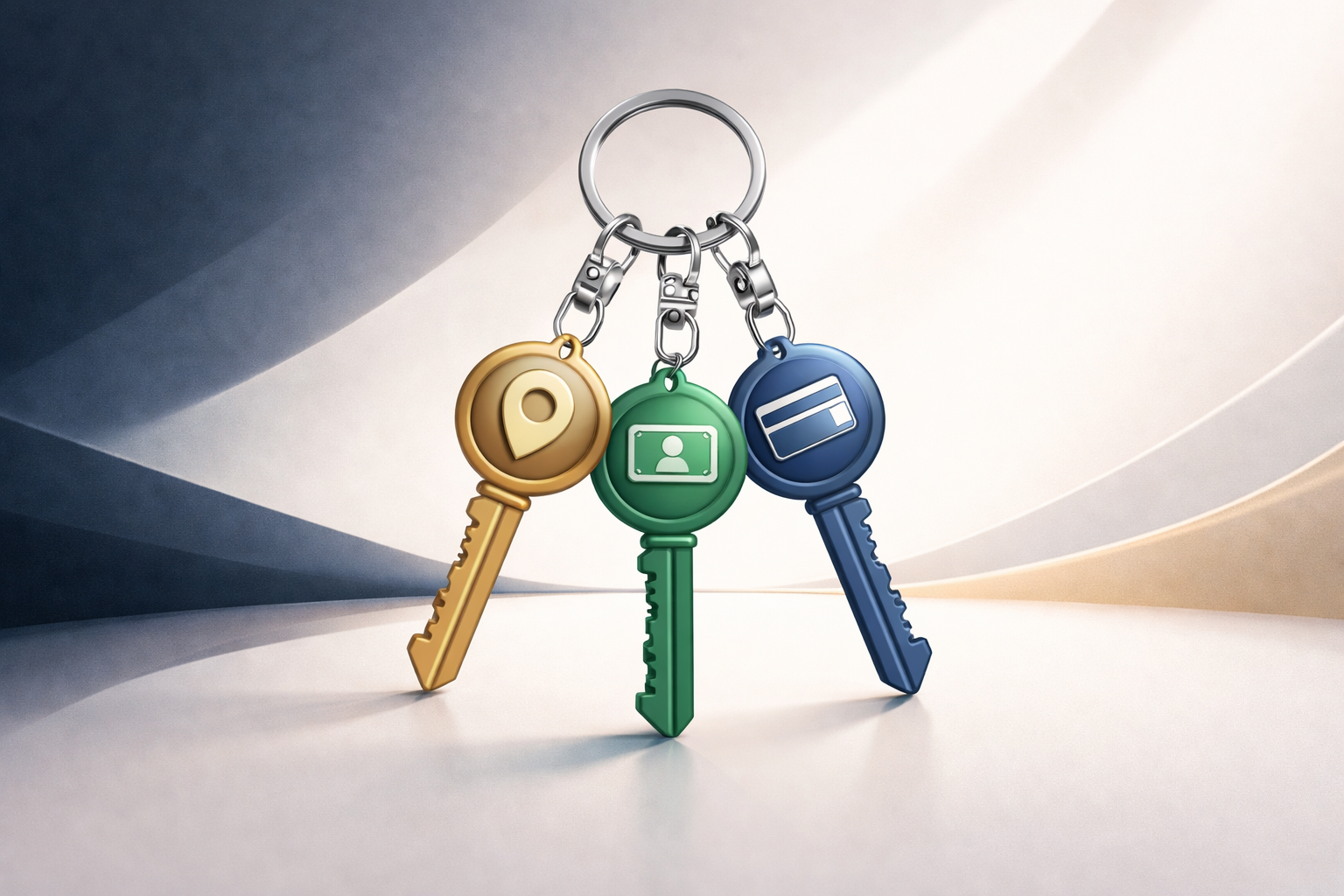
Your data pays for nearly all the digital services and apps you use, whether you’re charged dollars or not. Data has real market value, measured in dollars, but since we have no way of seeing that value, we are conditioned not to treat it like our other valuable property. If you owned a house and wanted to sell or rent it, you would not hand out spare keys to thousands of strangers. You would not let people wander the property unsupervised, and you certainly would not let them move in before signing a contract. But that is exactly how most people conduct business with their data.
There are three ways to sell property: do it yourself carefully, do it yourself haphazardly, or hire an agent to do it responsibly. As we walk through the concept of selling property in the context of data, it’s essential to understand what data buyers want, because it completely defines how you should approach the transaction.
What Data Buyers Want
A misconception that the current system exploits is that most people assume companies need control of and unfettered access to your raw data, such as GPS coordinates and search logs, to make better products. They don’t. What the market needs are the derivatives of the data.
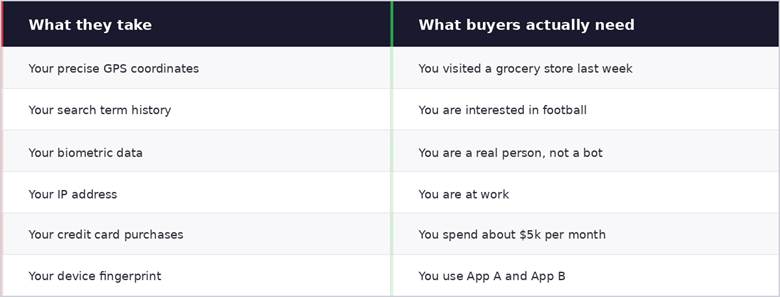
Data aggregators and data brokers know this, which is why they don’t ask you for insights. They prefer to offer you false dilemmas, take possession of your property, and thrust automatic opt-ins on you so they can extract whatever they want from it, whenever they want, without asking you again and without paying you when it’s used. It’s the difference between a potential buyer inspecting a house and a potential buyer tearing open the walls to strip the copper wiring because they wanted the metal.
The industry’s overreach comes at the expense of consumers and fortunately it can be overcome. If what the data buyers need are descriptions and derivatives of your data, and not the data itself, then data does not need to leave your control. You can collect and hold your own data much more reliably than any company could. Once you hold it, with a little help, you can provide data buyers safer, supervised ways to observe what they need and lock the door once they leave. The distinction between custody and access is subtle but monumentally important. It’s the difference between handing a stranger the keys to your house and allowing them in as a guest.
Given this reality, you have three choices for how to handle your digital property.
Option 1: For Sale by Owner
One way to sell your data is to do it yourself. Find the buyers, coordinate with them, show off what you’ve got, draft the terms, negotiate a price, and execute the transaction on your own. This is the digital equivalent of “For Sale by Owner” with no middleman, full control, maximum profit on paper.
For certain people, and for certain assets, this approach works. If you have the motivation, the time, the technical literacy, and the budget to manage how every company interacts with all your data, then more power to you. But be honest with yourself about what that requires. You’d need to find potential buyers, understand what your data is worth to each specific buyer, how to package it, how to enforce the terms of the deal, and how to prevent the potential buyers from overstaying on your property. Most people do not have the bandwidth to sell their own house by themselves, nor do they have the resources to sell their data alone.
Option 2: Hand Out Spare Keys (This Is What You’re Doing Now)
Since selling data yourself isn’t viable for most, you’re doing business in a way that’s most convenient to potential buyers, regardless of whether they’re genuine or deceitful. They prefer to have unfettered access, so you provide them with spare keys to your house. While some potential buyers are reasonable people looking for a home, others have ulterior motives that conflict with your best interests. This is what every “Accept All Cookies” click, every app permission grant, and every “I agree to the Terms of Service” tap represents. You just cut another key and gave strangers unsupervised access to your property.
The big problems start after you let them in. Some shout, “squatters’ rights!” and start using your property as if it were theirs. They invite over their friends, people you’ve never heard of or agreed to let in, access whatever they get their hands on, and do things with your couch that are illegal in certain jurisdictions. These unwelcome jabronis monetize what they see by profiling your behaviors, tracking your movements across multiple apps and services, and logging sensitive identifying characteristics.
Your front door is now effectively always unlocked for certain interlopers. You technically consented, not to the squatters, not to their friends, and certainly not to whatever they’re doing to your couch, but to the initial terms that made all of it possible. Getting them out now requires time, effort, and legal leverage that most people don’t have. Leaving them in place increases the risk they find and steal your other valuable property.
Remember: these people didn’t even need to move in. They just needed to look around! You gave them the keys anyway.
Option 3: Get an Agent (What You Should Be Doing)
The third way to sell your data, and the way people can do it but largely are not yet, is through an agent. A good agent sources and coordinates with buyers on your behalf. They escort potential buyers around the property, making sure buyers can observe enough for legitimate purposes and not harm the property’s value. When the showing is over, the agent escorts the buyers out. Nobody moves in without a signed contract of terms you explicitly agreed to.
Your property does not need to be passed around for the market to function, it just needs to be described accurately by someone representing your interests. A good agent understands what buyers are looking for and can perform this function for you. They don’t let buyers rip open the walls to inspect the plumbing. Your agent can identify what the potential buyer needs for a specific purpose. For example, a grocery store app does not actually require: 1) a log of your precise GPS coordinates; 2) your license plate; 3) your employment information; nor 4) the ability to sell that information to third-parties.[1] The grocery store only needs to know when you are ready to shop and what items you may be interested in purchasing.
Knowledgeable agents can identify unfair offers and require potential buyers to reveal competitive offers instead, saving you from wasting time. For example, a worthy agent would quickly reject an offer of $1 for data that’s worth $10. They also can research and keep a log of untrustworthy companies on your behalf. A diligent agent would advise you to stop doing business with companies that demonstrate a long history of alleged or proven abuse of their users’ data[2],[3],[4] and recommend viable alternatives. Finally, they can provide or recommend services that help you protect yourself from unwanted data collection.
The Missing Piece
Representation is the critical piece missing from the data economy and where regulation falls short. Regulation can tell companies what they should not do with your data, but it cannot execute what you want done with it. You do not need a better lock. You do not need a new contract from every company that wants access to your property. You do not need more granular cookie settings. What you need is representation, a seat at the table to make sure you and your property are treated with respect.
My Data Union exists to stand between your data and the thousands of entities that want access to it. You decide how you want to use your property, and we will execute your instructions. We will find the right buyers and negotiate for the best price, carefully supervise the data buyers in the process, and escort buyers out once the transaction is completed. If you’re ready to control, monetize, and protect your data the right way, sign up below and receive early access to the tools and representation you need in the data economy.
[1] https://www.kiro7.com/news/investigates/kiro-7-investigates-grocery-loyalty-programs-sell-shopper-data-millions/XFSUHIDGUZBRHN4UZGILP4OQKU/
[2] https://www.texasattorneygeneral.gov/news/releases/attorney-general-ken-paxton-sues-allstate-and-arity-unlawfully-collecting-using-and-selling-over-45
[3] https://www.business-humanrights.org/it/latest-news/usa-class-action-lawsuit-accuses-life360s-tile-tracking-device-of-violating-privacy-and-enabling-stalking/
[4] https://www.classaction.org/news/life360-secretly-sells-users-geolocation-data-to-third-parties-class-action-claims