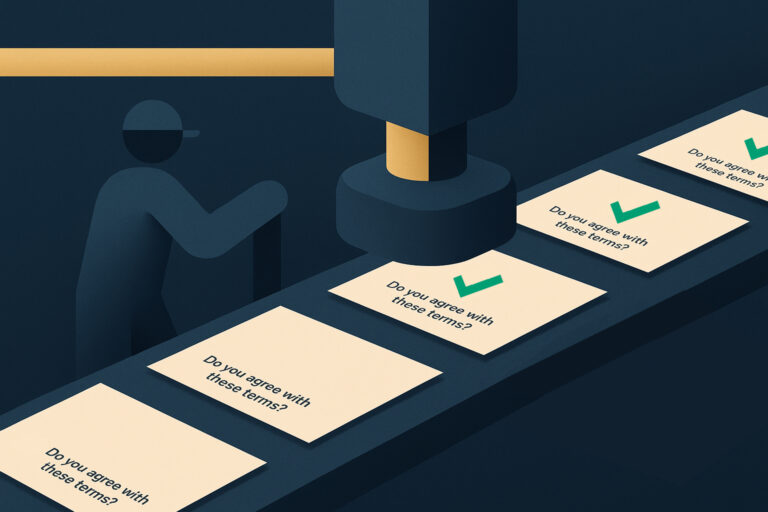
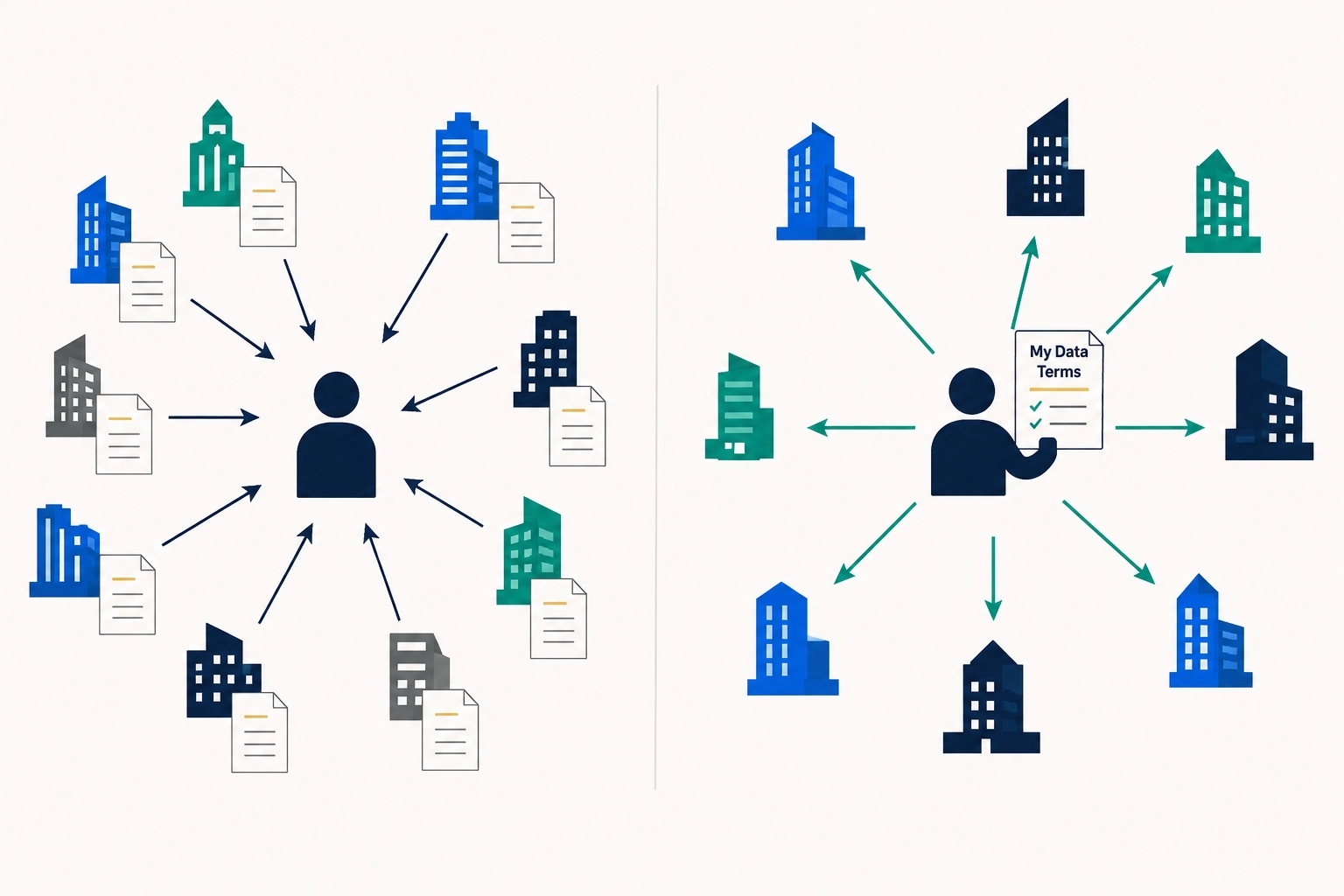
According to the data economy, your data is your responsibility to manage. For every product you use, you’re expected to understand how a company can use your data at a moment’s notice. And if you didn’t? Well, you agreed to the terms, so whatever happens next is on you.
That’s not a serious way of doing business and you deserve better. To highlight the absurdity, I did the math on what “personal responsibility” requires. Once you see the number, you’ll understand this was never a job for one person.
So let’s give the job to Paula for a week.
One week with Paula
Paula is not careless. She locks her doors. She reads her mail. She checks her bank statements. By every normal standard, Paula is a responsible adult.
Monday. Paula’s phone prompts her to accept updated terms from Google before she can check her email. She taps ‘I Agree,’ because the alternative is not having access to her email. That agreement, Terms of Service + Privacy Policy, runs about 11,000 words. Forty-five minutes of reading, if she’d read it. She also has accounts with Meta, Amazon, Apple, and Microsoft too, plus a Visa in her wallet, and she recently tried one of the big AI assistants. Let’s call it eight relationships like this, totaling 88,000 words of legalese homework.
Tuesday. Paula’s doctor moved to a new patient portal. She creates an account between meetings, hastily tapping ‘I Accept’ and refills a prescription in the pharmacy’s app. Her bank also emailed to say it updated its terms, which was routed to her spam folder. She ignores the email, and her bank interprets her silence as an agreement to the new terms. Her health insurer, hospital portal, bank, credit card, and pharmacy, five relationships with documents totaling 9,000 words each. 45,000 words on Tuesday. Running total: 133,000 words.
Wednesday. Paula’s new TV arrives today. It’s a regular TV with a screen and a cable …except this TV’s terms require Paula to get her houseguests’ consent to being recorded, or she will be in violation of wiretapping laws.[1] She’s expected to have a strange legal conversation with anyone else in her home. Paula’s TV watches what she watches.[2] Her car collects whatever it can access.[3] And finally, then the smartwatch, the router, the doorbell, and Windows itself, all have its own terms about what it collects from everything she does on the machine. Call it seven devices and systems at 8,000 words apiece. 56,000 words. Running total: 189,000.
Thursday through Sunday. App time! Paula has about fifty of them from companies that aren’t from the tech giants, like the parking app, her kid’s soccer league app, the meditation app, the airline, and the grocery store’s loyalty program. Each one comes with its own terms and privacy policy, say 7,000 words per app. 350,000 words. Final total: 539,000.
Half a million words
Let’s be fair to Paula and assume she reads at the average adult pace of about 240 words per minute and never needs a legalese sentence explained to her. Reading what she agreed to, just once, would take her 37 hours. For scale, War and Peace is 587,000 words. From just a week’s worth of activity, Paula’s expected to decipher a Tolstoy novel written by lawyers. Immediately.
But Paula is diligent, and perhaps a touch masochistic. She read it all…so now what?
- The things she read can be changed at any moment, at each company’s discretion, forcing her to repeat this process 2-3 times per year, per service.
- When Paula objects to certain portions for the apps and services she cares most about, no one cares. She has no one to contact to make her own conditions. Instead, she’s forced into an all-or-nothing transaction.
Nobody reads these agreements, and the system is designed around that fact. Every “I Agree” Paula tapped was manufactured consent, a false choice between accepting unread terms and living without email, a doctor, a bank, or a job.
Consent didn’t die because people got lazy. It died because it was scaled past the point where a human being could ever give it.
We already know what to do when the paperwork outgrows the person
In every other area of Paula’s life where the documents got too complex and the counterparty too powerful, nobody expects her to go it alone. Paula doesn’t read investment prospectuses; her retirement plan has a manager with obligations to her. If she sold a house, an agent would work the deal. If she were sued, a lawyer would speak for her. Athletes don’t negotiate their own contracts, and neither do actors. As I’ve argued in Your Data Needs An Agent, everyone who creates value gets representation to work for them. For some reason, the exception has been the people generating the data economy’s lifeblood.
Companies could never get away with treating another company like this.
When the fragmented briefly organize, they win
Don’t take it on faith that the other side of the table would ever budge. Look at what disorganized users, with no mandate and no plan, have already done.
In 2012, Instagram’s new terms implied user photos could appear in ads. The public revolt was loud enough that Instagram reversed the language within days and apologized.[4] In 2021, WhatsApp pushed a privacy policy expanding data sharing with Meta, and tens of millions of people downloaded Signal and Telegram within weeks. WhatsApp delayed the rollout and spent months trying to win back trust. In 2023, Unity announced a retroactive fee on game developers, who organized a boycott so fast the plan was scrapped and the CEO was out within a month. That same year, Reddit’s new API terms gutted the tools communities relied on, so volunteer moderators took thousands of communities dark. In 2024, Adobe’s terms hinted that customers’ work could feed AI training. Creative professionals erupted, and Adobe rewrote its terms in plain language.
Companies do not have morals, and their actions are determined by game theory to maximize profits over all else. Every one of those “wins” by people was improvised, and companies quickly folded to gain favorable press and extinguish a fire. But the moment the outrage evaporated, most companies reintroduced similar terms, under the radar.
Wildcat strikes win battles. Organized blocs win wars.
What’s coming
Your data has value, I want to help you manage it better. To begin, I want to show you what your data’s worth, who’s taking it for free, and how to stop them from taking it.
Right now, at no cost to you, you can check out my tool, App Score. I read, score, and track the terms of the apps you care about so your 37 hours becomes a glance.
But the reading was only ever half the job. The other half is the mandate, a formal way to put someone on your side of the table. That piece is in the works right now, but I’ll tell you this much: It fits on one page. It’s written to be read once and understood. And it’s free, because you shouldn’t be charged to fix a problem you didn’t create.
Paula was never going to read half a million words. Neither are you. The ask was impossible from the start, and a system built on an impossible ask is really built on your surrender.
Join the newsletter and be first in line when it’s ready.
[1] https://tech.yahoo.com/home-entertainment/tvs/articles/pretty-revolting-lgs-tv-gaming-165444593.html
[2] https://www.texasattorneygeneral.gov/news/releases/consumer-alert-ken-paxton-warns-texans-about-ccp-aligned-smart-tvs-are-spying-them
[3] https://dicellolevitt.com/court-allows-gm-onstar-vehicle-data-privacy-lawsuit-to-move-forward/
[4] https://www.npr.org/sections/alltechconsidered/2012/12/20/167760242/instagram-reverts-to-original-ad-terms-after-uproar