Nosey neighbors always interject themselves into everyone else’s business to stay informed. Their top mission in life is to know which people meet on Thursdays for lunch, go for walks together, and shop at the same stores. Your devices are surrounded by nosey neighbors. Instead of using the information as social capital, these neighbors are companies, and they meticulously record information about your devices’ communications. Let’s review how data travels around the internet and how companies can opportunistically harvest consumer data.
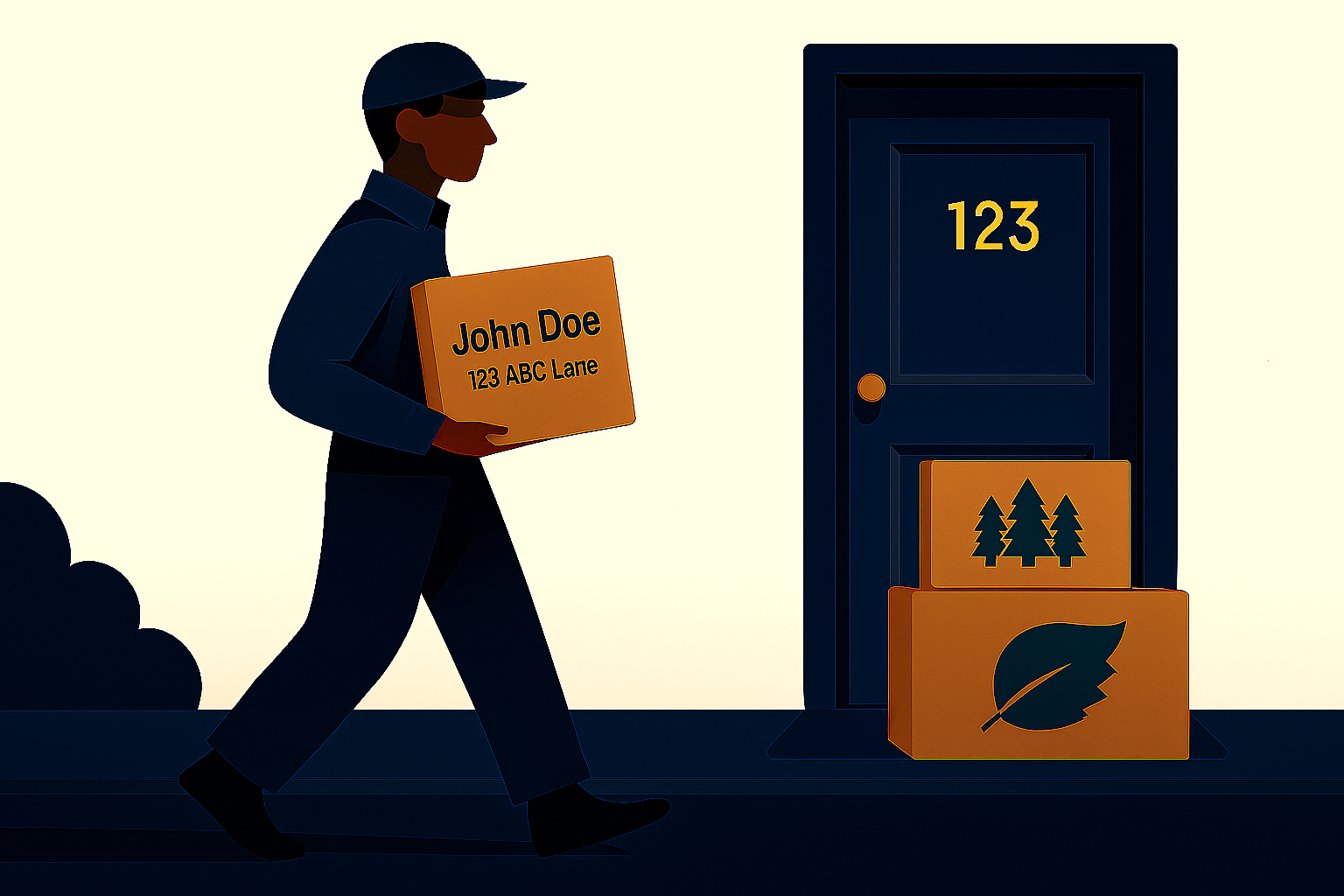
When offering an analogy about how the internet works, then-eighty-three-year-old Senator Ted Stevens proclaimed, “It’s a series of tubes.”[1] And then he was ridiculed for being old and out of touch. Poor Ted; if he was still alive, I would tell him that I thought his analogy was pretty good. However, he isn’t, and the internet is actually a mail-delivery system in charge of connecting our messages and packages to us. Many different rules, interchanges, and intermediaries exist to perform specific tasks in tandem. Here’s a simplified schematic of how it works:
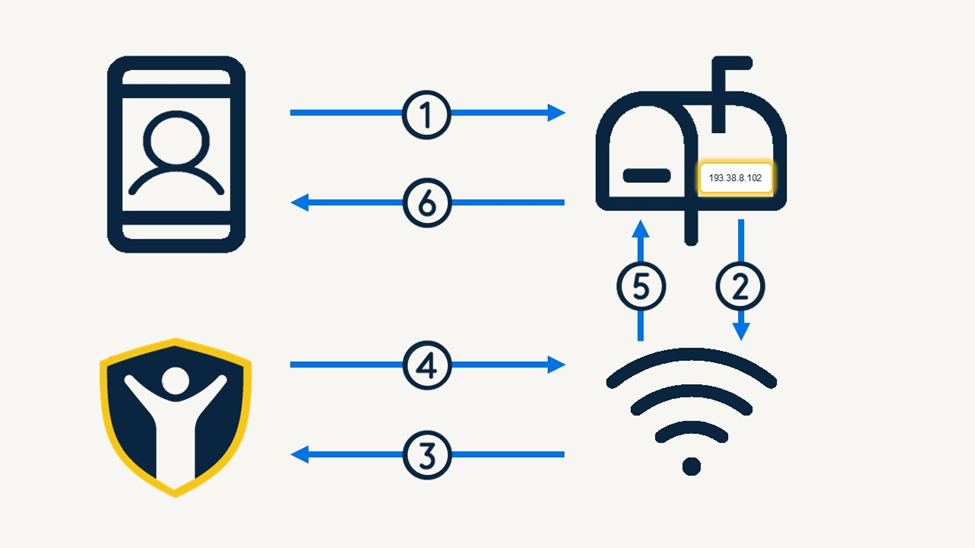
- When your device needs to access a website, app, or anything else not contained within it, the device creates a data package requesting the information you want, such as asking My Data Union for permission to read this post. The device addresses the request for My Data Union and places it in an out-bound mailbox, ready to be picked up for delivery. It is the same process as sending your family holiday cards. You must write the card, seal it in an envelope, address the envelope and then leave it in your mailbox for the USPS to pick it up.
- Since your device wants to hear back from My Data Union, your device needs to tell My Data Union where to send its reply. Just like writing your home address in the top left corner of your envelope as the “return to sender” address, the device writes its numeric IP address as the return destination. In the above example, “193.38.8.102,” is the device’s IP address, and it was included on the package it sent to My Data Union. An internet service provider (ISP) such as AT&T, Comcast, or Verizon, or the post office retrieves the package and brings it to its sorting facility.
- At the sorting facility, the package’s destination address is examined and relayed through its network before it arrives at the destination address.
- My Data Union and your family received the packages, read the contents, and created their own package to reply. My Data Union sends the contents of this website to the ISP, and your family sends their holiday card to the post office.
- The post office and ISP sorted the packages. They deliver the packages to the return addresses.
- The new package is successfully delivered to your address, and you read the contents.
While the process is combined with reliable security protocols that guard the contents of a package, it reveals valuable and identifying information about people that companies involved in steps 2 through 5 opportunistically harvest. The IP addresses used by devices and the companies with which they communicate are revealed in plain sight, listed on the outside of the packages. The information is used as a personal identifier that binds them with other details about your behavior and demographic.
Imagine what a curious mail-carrier could learn about you by observing the things delivered to and sent from your address without needing to open the packages. Believe it or not, companies pay a lot of money for this type of knowledge about consumers’ behavioral and demographic data. Mobile apps, payment processors, email providers, and other companies that operate between steps 2 through 5 combine the data they hoovered (sucked up, as does a vacuum cleaner) about their users with personal identifiers to monetize your behavioral data. Here are a few examples of what companies pay for:
Frequency of deliveries
Mail-carriers across the U.S. probably know if someone is an Amazon Prime member without being explicitly told. Red Stag Fulfillment, a freight and delivery company, estimates Prime members spend about $2 for every $1 non-Prime members spend on Amazon, totaling about $1,200 per year of purchases.[2] It is safe to assume that a Prime members’ home address receives more Amazon packages than a non-Prime member’s home address. Just like mail-carriers see which home addresses receive the most Amazon boxes, companies operating in steps two through five observe which IP addresses exchange the greatest number of data packages with Amazon. Internet browsing and shopping apps identify devices that search for the same type of product multiple times are probably interested in buying it or a similar product. Email services detect order confirmations and digital receipts that devices receive when the owners complete the purchase. And ISPs document the communication patterns between a device and other companies. The browsers, email providers, and ISPs are types of data aggregators, and they sell interest and intent insight about consumers to data buyers.
Package sizes
Your mail-carrier can distinguish between a 65” television and postcard based on the packaging dimensions and weight. Similarly, the data packages your device exchanges while streaming a 4K video are notably different from when it displays this article. Data buyers want to know when consumers receive certain sized packages. For example, a data buyer may want to buy authentic, anonymous statistics about consumers who stream television shows.
Location
Where are you when you send a message or check your phone at 8pm on any given Monday? Or 11am on a Tuesday? You are probably home or at work. Companies that send and deliver messages, such as those involved in steps 1 through 6, know that, too.
They see which IP addresses devices use the most and the times the IP address is used. Companies also maintain extensive IP address directories to approximate the physical location of a device based solely upon its IP address.[3]
Companies pay to be informed everywhere devices travel. They want to know when devices leave home or work to visit a point of interest, such as a stadium, gym, or store. Companies also want to know which devices are frequently near other devices, indicating which people are associated with each other. Over time, the data provided by many people and devices illustrate valuable migration, behavioral, and demographic trends. The property is sold to companies wanting to quickly identify and monetize changes in trends.
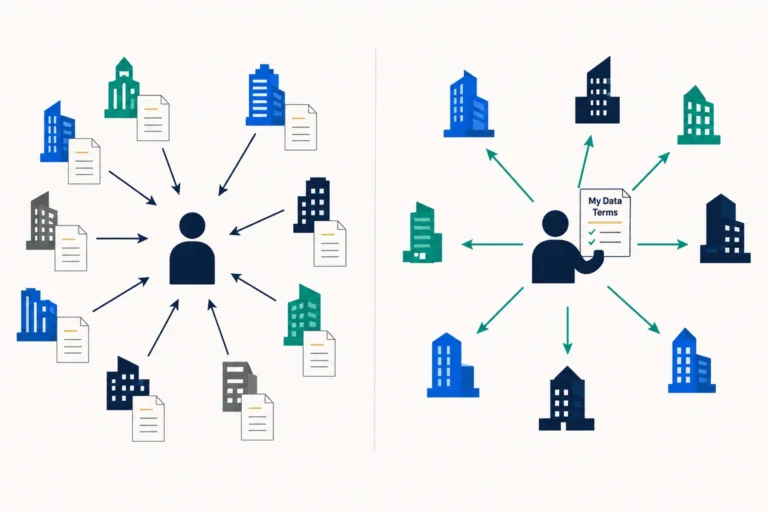
People understand that the company providing them with a product or service monitors their activity with the company. What they may not appreciate is how many others see the information and glue it with unique identifiers, such as IP addresses, email addresses, and device fingerprints, to create comprehensive consumer profiles. Instead of consumers dictating terms and profiting from their property, middlemen, such as data brokers, step in to capture the value for themselves. Unfortunately, the middlemen taking the value from consumers do it in a reckless fashion that increases people’s risk for theft and fraud.
My Data Union supports consumers who want to control how their data is collected, used, and monetized. The amount of information consumers know about themselves is unique, which is a distinct advantage in the marketplace. By providing its members with tools to intervene at steps 1 and 6, it can automatically collect the data members choose about themselves and their devices – the most reliable and comprehensive source of consumer data that no other entity in the market can replicate. Unfortunately, the people who own and generate the best data about themselves are the least able to profit from it. Consumers organized with My Data Union can not only participate but outcompete every single middleman in the market to reclaim the lost value for themselves. They can also use tools to thwart others from collecting their information without their consent, driving up their data’s value through scarcity.
If you want to access the market, you need tools to automatically collect your data. Data from individuals is not worth much, so you also need to combine your data with a collective to increase its value. My Data Union’s platform is built to provide its members with tools to collect and protect their data. Consenting members can contribute their data to an anonymous data pool, operated by My Data Union, to establish fair compensation from qualified buyers. My Data Union, which earns a commission to establish terms for its members, sources the qualified buyers and negotiates for the best prices on their behalf.
[1] https://en.wikipedia.org/wiki/Series_of_tubes
[2] https://redstagfulfillment.com/average-annual-spend-of-an-amazon-prime-member
[3] https://ipleak.net